A concise guide for policymakers, academics, civil society organisations, and peace practitioners.
1. How does the Parity Accord relate to the Good Friday Agreement — and how should it be evaluated?
The Agreement established a Three-Strand structure comprising internal governance, North–South cooperation, and British–Irish relations. These strands were designed to operate alongside one another, but without full constitutional integration.
The Parity Accord builds upon this foundation by providing the constitutional structure required to govern a shared society made possible by consent. It integrates and evolves the Three-Strand framework into a single constitutional system in which each strand performs a distinct structural role.
It addresses a structural problem left unresolved by the Agreement: how two enduring communities may inhabit a single political space without one being experienced as overriding or displacing the other.
For this reason, the Accord is not properly assessed as a discrete proposal, but as a complete constitutional system. Its evaluation requires consideration of the full framework through which parity, non-domination, and shared authority are structurally embedded:
-
Introduction: Evolving the Good Friday Agreement
-
The New Constitutional System
-
The Policy Paper – Sixteen Pillars
-
Strategic Defence of the Parity Accord
Together, these enable legal, institutional, and comparative evaluation of how parity, non-domination, and shared authority are embedded across the framework.
2. What makes the Parity Accord structurally distinct from existing constitutional models?
The Parity Accord introduces a distinct constitutional approach centred on Identity-Anchored Shared Sovereignty.
This approach is expressed through interlocking structural mechanisms that secure permanence, prevent structural domination, and restore representational continuity without territorial redesign.
Taken together, these elements form a constitutional model not reducible to federalism, consociationalism, autonomy frameworks, or unitary redesign. They instead define Parity as a constitutional form grounded in structured equilibrium, where legitimacy arises from balance rather than majority dominance.
The Parity Accord embeds parity as a condition of constitutional legitimacy, ensures protections operate independently of political agreement or majority discretion, and integrates these principles across the full architecture of governance.
In this sense, it represents not a variation of existing systems, but a distinct constitutional form — Paritary — defined by its parity-based organising logic.
3. How is the Parity Accord structured as a constitutional model?
The Parity Accord operates as a layered constitutional framework, integrating distinct functions into a single coherent architecture.
The term Paritary derives from the French paritaire, meaning based on parity or equal standing.
Within this framework, it is used to describe a constitutional form in which balance is embedded as a structural condition of legitimacy rather than as a political outcome.
It is organised across four interlocking constitutional layers:
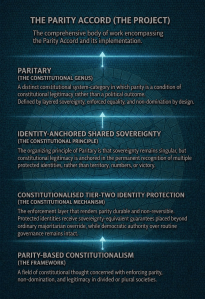
Each layer performs a distinct constitutional role within an integrated framework, progressing from framework and principle through mechanism and constitutional form to practical implementation:
-
Agreement Layer → secures consent and democratic legitimacy
-
Genus Layer (Paritary) → defines the constitutional form
-
Principle Layer → anchors authority in protected identity rather than territory, numbers, or victory
-
Mechanism Layer → enforces parity through durable constitutional safeguards
This layered design ensures that legitimacy, structure, and enforcement operate as a unified constitutional system. As reflected in the structural diagram above, the framework operates as a constitutional mosaic: each component is interdependent and non-severable, such that the removal or weakening of any element alters the structural balance and permits dominance to re-emerge.
Parity therefore operates as constitutional architecture, not political aspiration.
Enforcement and Institutional Integrity
Parity within this framework is not enforced through a centralised authority or a supra-constitutional body.
Instead, it is secured through distributed constitutional mechanisms operating across existing institutions.
These include:
-
judicial review within established courts;
-
structured power-sharing requirements within executive and legislative institutions;
-
procedural safeguards that prevent unilateral decision-making;
-
institutional design that removes the capacity for sustained dominance at source.
In this model, parity does not override democratic authority.
It defines the conditions under which democratic power may be exercised without converting participation into structural control.
No single institution is elevated above the constitutional order.
Authority remains distributed, accountable, and embedded within existing legal and democratic frameworks.
4. Does Paritary constitute a new constitutional genus?
On comparative constitutional grounds, Paritary may be understood as constituting a distinct constitutional genus rather than a variant of existing models.
In constitutional terms, a system approaches genus status where its organising logic operates across multiple constitutional foundations without reliance on:
-
territorial redesign
-
demographic dominance
-
elite accommodation
A system attains genus status where its organising principle remains structurally intact across distinct constitutional environments without requiring reclassification into existing models.
Paritary meets this threshold by introducing a parity-based constitutional logic that is structurally binding, non-optional, and capable of operating across different systems.
A defining feature is its dual constitutional capacity. It may operate either as a retrofit model within existing systems or as a founding constitutional framework.
This enables institutional continuity while preventing structural domination by design.
Its transferability is not asserted in the abstract. It is demonstrated through companion frameworks developed across distinct constitutional contexts, including:
-
the United States and Canada (federal systems)
-
the European Union (supranational governance)
-
the United Nations (international institutional framework)
-
South Africa (post-conflict constitutional order)
These applications are not prescriptive models. They do not propose institutional replacement or uniform constitutional outcomes.
They serve as comparative demonstrations of how parity-based design may be adapted within existing legal systems, political traditions, and governance structures.
This reflects a core principle of the Accord:
constitutional systems must determine their own arrangements based on democratic will, institutional context, and legal tradition.
The Accord does not merely assert a new category; it is structured to satisfy the conditions by which such a category may be recognised under comparative constitutional analysis.
Where constitutional systems do not permit binding constraints, prior structural adjustment is required. This does not weaken the model — it defines the conditions under which non-domination is legally possible.
5. How can the reliability of this model be assessed in the absence of direct precedent?
Constitutional systems are not replicas; they are structured integrations of established principles.
Elements of parity and identity protection are present in existing systems. For example:
(a) consociational arrangements, such as Belgium, embed group representation within governance structures;
(b) European institutional frameworks recognise plural identity and balance across Member States;
(c) post-conflict settlements, including the Good Friday Agreement, incorporate principles of parity and non-domination;
(d) systems such as Bosnia and Herzegovina constitutionalise identity within governance structures, demonstrating both the necessity of recognition and the risks of rigid, group-based entrenchment.
These examples demonstrate that while the underlying principles are recognised in practice, they have not been fully systematised into a single constitutional form. Where identity is insufficiently structured, instability persists; where it is rigidly fixed, governance can become constrained and difficult to adapt.
Reliability is therefore assessed through the coherence of design, the constraint of power, and the system’s capacity to withstand political stress.
The Parity Accord addresses a longstanding challenge: how democratic systems remain stable when constitutional change is experienced as existential loss.
Rather than relying on majoritarian dominance or contingent arrangements, it embeds non-domination as a constitutional condition.
Its reliability is therefore structural, not historical.
6. How does the Parity Accord address concerns about rigidity, identity definition, and governance efficiency?
Such concerns arise in all systems that incorporate strong safeguards.
The Parity Accord addresses them through:
-
built-in review mechanisms;
-
adaptive institutional design with defined adjustment procedures;
-
clearly defined and limited protections.
These safeguards operate through distributed institutional design rather than centralised authority.
This ensures stability without rigidity, protection without paralysis, and effective governance within constitutional limits.
7. Is this framework intended for situations where identities or ideologies cannot be reconciled?
Yes.
Paritary is designed for societies where enduring identities or ideological traditions cannot be safely absorbed into a single majoritarian framework.
It does not require uniformity. It secures coexistence through institutional structure, ensuring that participation does not become subordination.
Stability is therefore achieved through structured inclusion rather than forced alignment.
8. Does this go against democracy — since democracy normally produces a winner?
No.
Democracy determines leadership and policy, not belonging.
The Parity Accord preserves democratic choice while redefining its consequences. Voting remains decisive, but cannot produce structural domination.
Consent governs outcomes; constitutional structure ensures inclusion.
Democratic authority is retained, but its effects are constitutionally bounded.
This reflects an established constitutional principle: in existing democracies, majority decisions are already limited by fundamental rights and legal safeguards. The Parity Accord extends this logic by embedding non-domination as a core constitutional condition.
9. Does Paritary preserve stability during constitutional change?
Yes.
Continuity is preserved while structural failure points are redesigned.
What changes is the underlying constitutional logic:
-
from winner-takes-all → to shared authority;
-
from vulnerability → to protected participation.
Paritary preserves continuity while redefining how constitutional change is experienced — not as loss, but as structured inclusion.
10. Is the Parity Accord a political campaign or advocacy project?
No.
It is a constitutional design framework offered for institutional review, negotiation, and adaptation.
It is not aligned with any political party or movement.
Its purpose is institutional, not political.
11. What inspired the Parity Accord?
The Accord emerged from sustained study of divided societies, peace agreements, and institutional failure.
It draws on comparative constitutional practice and post-conflict governance experience.
Its purpose is to establish constitutional fairness, durable identity protection, and structured inclusion.
12. Who is the Parity Accord written for?
The framework is intended for:
-
governments and constitutional negotiators;
-
commissions and mediators;
-
academics and researchers;
-
civil society organisations.
It is designed for institutional evaluation, negotiation, and adaptation within real constitutional settings.
13. Why does the author remain anonymous, and how can the framework be trusted?
Anonymity preserves neutrality and ensures the framework is evaluated on its constitutional substance rather than personal identity.
Its legitimacy rests on:
-
legal coherence and internal consistency;
-
institutional compatibility with existing systems;
-
transparency of structure and constraints;
-
openness to independent scrutiny and institutional review.
The Parity Accord is a fully examinable constitutional framework.
Anonymity does not remove accountability. It shifts it from personal authority to structural integrity and public scrutiny.
Where required, engagement may take place through structured institutional channels while preserving neutrality.
The framework is therefore validated through analysis and review, not authorship.
14. How does symbolism (such as flags) fit within the Irish context?
Symbolism follows structure, not the reverse.
In this framework, constitutional arrangements are established first to ensure balance, inclusion, and non-domination.
Symbols may reflect these principles, but they do not determine them and carry no governing authority.
As John Hume observed:
“You can’t eat a flag.”
Symbolism therefore expresses constitutional reality; it does not create it.
15. Does the Parity Accord permit structured critique and refinement?
Yes.
The framework is open to scholarly analysis, institutional review, and structured critique.
Engagement is encouraged where it strengthens:
-
coherence of design;
-
durability of safeguards;
-
constitutional integrity.
 The Parity Accord