Prepared for Expert Review and Policymaker Consideration — Grounded in Consent and Parity
Executive Summary
This document sets out a constitutional framework for a shared system of governance designed to support stable administration, legal continuity, and balanced representation across the island. Building on the principles of the Good Friday/Belfast Agreement (1998), it translates those commitments into an operational constitutional structure capable of sustaining governance over time.
It establishes a fully integrated system of internal governance, North–South cooperation, and British–Irish relations within a single constitutional framework.
These three dimensions correspond to the three strands of the Good Friday/Belfast Agreement and are here evolved into a Unified Three-Strand Architecture, operating as an interdependent constitutional system rather than parallel institutional arrangements.
Rather than relying on informal understandings or political goodwill, the framework embeds stability through institutional design. It operates to prevent majoritarian control, establish parity in decision-making, and maintain institutional and economic continuity during and after constitutional transition. In this respect, it develops consent beyond a procedural threshold and gives it durable constitutional form.
Approved by referendum in both jurisdictions, the Agreement authorised constitutional change by consent while leaving key aspects of institutional design unresolved. The Parity Accord builds on that democratic foundation by providing a constitutional architecture for those unresolved questions. It does not replace consent; it gives consent institutional form and is designed to prevent its outcomes from resulting in structural domination or institutional imbalance.
Where parity of esteem is recognised in principle, this framework establishes it through enforceable constitutional design. Identity protections and governance balance are insulated from political majorities and demographic fluctuation, with status, participation, and belonging not made conditional on electoral outcomes.
The model defines core constitutional institutions, decision-making procedures, and the distribution of powers across national, regional, and shared levels, supported by cross-community leadership, legislative balance, and independent constitutional oversight.
A constitutionally defined system of intergovernmental and East–West coordination preserves continuity across rights, mobility, trade, and public services. Legal protections provide for the preservation of access to entitlements as constitutional arrangements evolve, and maintain continuity of civic participation without interruption.
At the same time, a phased implementation pathway provides for institutional development, administrative alignment, and policy harmonisation, allowing transition to proceed through managed continuity rather than systemic disruption or displacement.
Taken together, these elements form a complete operational framework rather than a conceptual model. This document therefore provides the institutional architecture for implementing balanced, lawful, and durable governance.
A formal constitutional and institutional version of this document is available at: The New Constitutional System — Full Constitutional Model (Judicial and Institutional Version)
Foundational Constitutional Design Principles
This constitutional system is structured around six interlocking principles, which define how authority is constituted, constrained, and sustained in practice.
The six principles are:
-
Constitutionalised Tier-Two Identity Protection
Identity is protected beyond political majorities and embedded in constitutional law. -
Identity-Anchored Shared Sovereignty
Constitutional authority operates across identities without territorial domination or hierarchical control. -
Neutral Administrative Centre
A centrally located constitutional centre supports impartial governance and prevents institutional alignment with any single tradition. -
Overlapping, Reparative Representation
Representation is structured to correct imbalance rather than reinforce division, enabling participation across identities and jurisdictions. -
Unified Three-Strand Architecture
Internal governance, North–South cooperation, and British–Irish relations operate as a single constitutional system rather than parallel processes. -
Structural Stability (Institutional Anti-Fragility)
Safeguards and procedures support resilience under political stress, allowing disagreement to be absorbed without institutional failure.
Together, these principles establish parity as an enforceable structure rather than political aspiration.
Constitutional Legitimacy and Decision-Making Balance
To prevent dominance by any single community, the system operates through dual-source constitutional legitimacy. Major constitutional and institutional decisions require support across the principal identity traditions, providing for balance without enabling unilateral control.
Rather than relying on permanent vetoes, the framework establishes structured mechanisms through which legitimacy is shared and exercised. These include parity-based decision pathways, defined negotiation procedures, and independent constitutional oversight.
Authority is therefore distributed across institutions rather than concentrated within them, preventing both sustained dominance and institutional paralysis.
This enables protection without paralysis and authority without domination. Stability is supported through institutional design rather than electoral fluctuation, addressing the limitations of both majoritarian systems and rigid consociational models by embedding non-domination and shared authority directly within constitutional structure.
Core Objectives
The framework is designed to achieve a set of interrelated constitutional objectives.
Political stability is supported through structured power-sharing mechanisms that prevent majoritarian control and support inclusive governance. Political stress is absorbed through institutional design rather than escalated through competition.
Balanced representation is maintained through regional legislative participation within a cohesive constitutional framework. This allows political belonging to extend beyond territorial boundaries, addresses historical imbalance, and removes the need for border change or institutional absorption. Representation is therefore expanded without displacement.
Institutional neutrality is achieved through a central administrative framework in which authority derives from structure rather than inherited centres of power, preventing dominance by any single identity tradition.
Rights and identity protections are embedded in constitutional law. Irish, British, and Northern Irish identities are formally recognised and permanently protected through:
-
Constitutionalised Tier-Two Identity Protection
-
Identity-Anchored Shared Sovereignty
These protections operate as enforceable guarantees rather than contingent political outcomes.
Economic continuity is maintained through coordinated governance across internal structures, North–South cooperation, and British–Irish relations. This supports stability in trade, regulation, and access to existing systems throughout constitutional transition.
Constitutionalised Identity and Sovereignty-Equivalent Guarantees
Within this framework, Irish, British, and Northern Irish identities are constitutionalised and protected through sovereignty-equivalent guarantees. Identity is recognised rather than created by the state, protected from political withdrawal, and insulated from demographic change.
These protections are operationalised through Constitutionalised Tier-Two Identity Protection and Identity-Anchored Shared Sovereignty, with identity remaining secure irrespective of political or institutional change and not subject to conditional recognition.
Clarifying How Identity Functions
To avoid the failures of systems that define or regulate identity, this framework embeds identity autonomy as a constitutional principle. Identity affiliation is voluntary, self-declared, non-exclusive, and capable of evolving over time.
This prevents absorption, marginalisation, and reduction of authority, with identity remaining self-determined while fully protected within the constitutional order. Participation is therefore maintained without requiring alignment, and recognition is maintained without institutional dependency.
Transition to the First Proposal
Having established the principles of non-domination, parity, and balanced governance, the framework now moves from principle to institutional design.
It begins with:
1. Proposal: Reviving Shared Institutions
1. Proposal: Reviving Shared Institutions
From the Council of Ireland to a Modern Governance Architecture
The Parity Accord builds directly on the Good Friday/Belfast Agreement’s principle of consent, providing that constitutional change remains lawful, democratic, and inclusive. It develops earlier institutional concepts into a modern framework for coordinated governance.
These concepts emerge from a continuous historical trajectory — including developments in 1920, 1973, 1984, 1985, and 1998 — reflecting sustained efforts to construct institutional mechanisms capable of managing relationships across the island.
Historical Basis for Shared Institutions
This proposal modernises key elements of:
-
the Government of Ireland Act (1920) — parallel legislatures and a Council of Ireland
-
the Sunningdale Agreement (1973) — executive coordination mechanisms
-
the New Ireland Forum (1984) — structured cooperation
-
the Anglo-Irish Agreement (1985) — intergovernmental engagement
-
the Good Friday/Belfast Agreement (1998) — consent and power-sharing
These precedents demonstrate a consistent recognition that shared institutional architecture is necessary for stable governance across jurisdictions.
A Structural Reality Acknowledged Since 1920
This framework is not grounded in ideology. It reflects a constitutional reality long recognised: the presence of two primary political and cultural traditions.
The system does not interpret or resolve that duality. It structures governance around it. The requirement is therefore institutional: neither tradition is absorbed, and neither is subordinated. Governance is organised to accommodate this condition through balanced constitutional design.
Key Structural Elements
Building on this continuity, the framework begins with:
-
two legislatures — Stormont and Leinster House — operating within a coordinated constitutional framework
-
a modernised Council of Ireland acting as a joint body for policy coordination and shared functions
-
structured cooperation mechanisms supported by defined competencies and oversight
These elements provide administrative continuity, procedural clarity, and predictable coordination, allowing existing institutions to evolve while enabling structured cooperation.
Purpose of Reviving Shared Institutions
The objective is to preserve operational continuity while expanding institutional capacity. This maintains continuity of governance, clearly defined authority, and predictable joint decision-making.
Institutional development proceeds through expansion and coordination rather than replacement or disruption.
Preparing the Ground for Constitutional Architecture
By building on existing institutions and proven mechanisms, the system evolves through legal continuity, operational stability, and incremental refinement rather than abrupt redesign.
This approach prepares the foundation for expanded shared governance, clarified competencies, and strengthened institutional balance within a framework grounded in consent and administrative practicality.
Transition to the Next Proposal
With shared institutional foundations established, a further question arises:
What form of governance ensures that shared authority remains balanced, impartial, and resistant to domination?
This leads to:
2. Proposal: A Swiss-Inspired Governance Framework for Ireland
2. Proposal: A Swiss-Inspired Governance Framework for Ireland
A Rotational and Collective Model for Balanced Executive Authority
This proposal draws on principles of the Swiss governance model, adapted to support stability within a multi-identity constitutional system. The objective is not replication, but structured adaptation — applying institutional mechanisms that prevent authority from being converted into dominance by any single group or tradition.
Switzerland demonstrates how rotational leadership, shared executive authority, and institutional neutrality can sustain long-term stability across diverse identities, regions, and political traditions. These principles are not abstract; they are operational features of a system in which authority is distributed, continuity is preserved, and legitimacy is shared.
Adapted to this context, they provide a constitutional foundation for structuring executive authority in a manner that prevents concentration of power while maintaining effective governance.
Key Principles Adapted from the Swiss Model
1. Rotational Leadership
In Switzerland, the presidency rotates, preventing concentration of authority within a single office or political group.
Applied here, leadership circulates in a predictable and legally defined manner across British, Irish, and Northern Irish identities. Rotation operates as a structural safeguard, preventing executive authority from becoming fixed, accumulated, or aligned with any one tradition over time.
Authority is therefore distributed through institutional design rather than political negotiation.
2. Collective Executive Responsibility
Executive authority is exercised collectively rather than through a singular executive figure. Decision-making is shared across a multi-member executive, requiring coordination, deliberation, and agreement.
This model enables continuity during periods of political disagreement, supports multi-party participation, and prevents governance from being defined by electoral dominance.
The executive therefore reflects constitutional balance as an ongoing condition, rather than a temporary political outcome.
3. Balanced Regional Autonomy
Swiss cantons retain autonomy while participating in national governance. This balance between self-government and shared authority provides stability without centralisation.
In this system, Northern and Southern institutions continue to exercise self-governing authority within their respective jurisdictions, while participation in shared governance is structured through defined coordination mechanisms.
Autonomy is preserved, but operates within a constitutional framework that supports cooperation, consistency, and mutual recognition.
4. Institutional Neutrality
Neutrality is achieved through institutional design rather than the absence of authority.
A neutral administrative centre, supported by safeguards preventing institutional capture, supports governance operating independently of regional, political, or identity alignment.
Impartiality is therefore embedded within the structure of the system itself, rather than dependent on political restraint or convention.
5. Direct Democratic Participation (Constitutionally Bounded)
Switzerland demonstrates the role of direct democratic participation in sustaining legitimacy through citizen involvement in governance. Referenda and civic initiatives enable ongoing engagement beyond electoral cycles, reinforcing the link between public consent and political authority.
Democratic participation is retained as a continuous feature of the system, enabling citizens to contribute directly to public decision-making within defined constitutional processes.
This participation operates within the framework of parity. No exercise of direct democratic authority may override identity protections, institutional balance, or the principle of non-domination. Citizen power is therefore preserved, while its exercise is structurally constrained to prevent democratic participation from being converted into dominance.
Why These Principles Provide a Suitable Foundation
Taken together, these principles establish a framework in which executive authority is structured to remain balanced over time. Rotation prevents concentration, collective governance distributes responsibility, and autonomy allows participation without requiring centralisation.
Institutional neutrality reinforces this balance by preventing any centre of authority from becoming aligned with a single tradition.
The result is a system in which legitimacy is sustained through shared authority, continuity is preserved through institutional design, and governance operates without producing structural dominance.
This is not a transfer of the Swiss model, but an adaptation of its underlying constitutional logic to a system in which identity, authority, and legitimacy must be held in balance simultaneously.
Transition to the Next Proposal
These principles raise a structural question:
Where should shared governance be located so that it remains neutral, accessible, and resistant to alignment with any single centre of power?
This leads to:
3. Proposal: Meath as an Administrative Province
3. Proposal: Meath as an Administrative Province
Establishing a Neutral Constitutional Centre for Shared Governance
This proposal establishes an Administrative Province: a neutral governance space located at the geographic centre of the island. It is designed to host shared administrative functions while operating independently of inherited political centres.
Reinstating Meath (Mide), the historic Fifth Province, provides a constitutional solution grounded in geographic centrality, historical continuity, and institutional neutrality. It creates a shared constitutional space that is not identified with any single tradition and does not derive legitimacy from existing centres of political authority.
This is not a symbolic designation. It is a structural response to a constitutional requirement: that shared governance must operate from a location that cannot be experienced as belonging to one tradition over another.
Neutrality Through Constitutional Design
Unlike the four-province framework, Meath is not embedded within contemporary political alignment. It does not reinforce territorial division, nor does it inherit the authority of Dublin or Belfast.
Neutrality is therefore achieved not by abstraction, but by institutional placement. Governance is located within a space that sits outside modern political ownership, so that no tradition is required to accept the symbolic centre of another.
The system is configured around neutrality as a constitutional condition rather than a political aspiration.
Shared Historical Reference Points
Meath enables recognition across the principal constitutional traditions without conferring exclusive ownership.
Its historical associations — including Tara and Uisneach as early centres of political assembly, the River Boyne as a central historical reference, and the Hill of Slane within shared Christian heritage — establish it as common constitutional ground rather than contested territory.
These references do not determine authority. They provide a shared historical context within which neutrality can be situated and understood.
Function Within the Constitutional System
Designating Meath as an Administrative Province introduces a neutral governance layer within the constitutional structure.
It recentres shared authority beyond Dublin and Belfast, preventing governance from defaulting to inherited centres of power.
This allows both existing institutions to continue operating within their jurisdictions while enabling shared governance to occur within a space that is structurally independent of both.
Governance is therefore organised beyond the logic of division while maintaining identity and institutional continuity.
Constitutional authority is exercised through a neutral centre rather than inherited capitals, preventing dominance by any single tradition.
Athlone therefore supports the operation of shared governance without functioning as a centre of political authority.
Purpose of the Administrative Province
Meath functions as:
-
a neutral constitutional anchor
-
a non-dominant administrative centre
-
a shared reference point for governance
-
a structural safeguard against the reassertion of legacy dominance
It operates as the stabilising centre of the shared governance system, with authority remaining balanced and institutionally grounded.
Transition to the Next Proposal
With the Administrative Province established, the next step is to identify the civic location capable of hosting its operational functions.
This leads to:
4. Proposal: Athlone as the Civic Centre of the Administrative Province
4. Proposal: Athlone as the Civic Centre of the Administrative Province
A Geographically Central and Structurally Neutral Hub for Administration
Athlone does not function as a centralised seat of political authority. It is established as a neutral administrative location through which shared administrative functions may be coordinated without transferring sovereignty, displacing existing institutions, or creating a new centre of control. Its purpose is to support balance, not to concentrate power.
It functions as both a practical and structural midpoint between regions, with the administrative centre grounded in accessibility as well as neutrality.
Historical Recognition of Athlone as a Central Hub
Athlone’s central position has long been recognised within Irish planning and administrative thinking.
During the mid-twentieth century, it was identified as a potential constitutional and economic midpoint capable of supporting a more balanced distribution of governance and development.
This recognition is illustrated in the planning reference below:
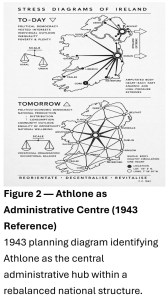
This reference demonstrates that Athlone’s role is not newly constructed or politically assigned. It reflects an established recognition of its geographic suitability for central administrative function.
Geographic and Structural Suitability
Athlone occupies a naturally central position on the island, located along key east–west and north–south corridors.
It is not associated with either tradition’s political centre, and its position along the River Shannon reinforces its role as a point of connection rather than division.
Geography therefore supports its function as a neutral administrative hub, supporting accessibility across regions without reinforcing territorial hierarchy.
Civic and Planning Capacity
Athlone’s designation aligns with existing development frameworks, including its recognition as a Regional Growth Centre, the presence of educational, commercial, and defence institutions, and its projected expansion under national development strategies.
Its role is therefore supported by existing capacity and planning trajectories rather than theoretical projection.
Function Within the Constitutional System
Athlone operates as the civic centre of the Administrative Province and the location for shared administrative functions.
It serves as a neutral centre of coordination, enabling governance across the island without displacing Dublin or Belfast, and without creating a new centre of political control. Governance is therefore coordinated through this neutral location rather than re-centred in any single capital.
It does not replace existing centres, nor does it transfer authority away from them. Instead, it allows them to operate within a shared constitutional structure, where governance is organised through a neutral location rather than a single governing capital.
Transition to the Next Proposal
With Athlone established, the system is prepared to introduce the institution responsible for coordination across the island.
This leads to:
5. Proposal: The Council of Ireland — Shared Governance Linking Athlone, Dublin, and Belfast
5. Proposal: The Council of Ireland — Shared Governance Linking Athlone, Dublin, and Belfast
A Permanent Institutional Framework for Coordinated Governance Across the Island
With the Administrative Province established and Athlone identified as the neutral civic centre, the next stage introduces the Council of Ireland. This is the institution through which structured cooperation, joint policy-making, and coordinated governance are exercised.
The Council is not a novel invention. It represents the continued development of a long-standing constitutional principle: that North–South cooperation requires permanent institutional structure rather than reliance on political goodwill or discretionary engagement.
Within this framework, cooperation is not optional. It is constitutionally structured, procedurally defined, and legally sustained.
Purpose and Function of the Council of Ireland
The Council forms a central component of the Unified Three-Strand Architecture. Its function is operational rather than symbolic, providing a structured forum through which cooperation can be exercised consistently across the island.
It enables:
-
joint decision-making
-
coordinated policy development
-
the management of cross-border issues
-
institutional linkage between both jurisdictions and the Administrative Province
Through this structure, cooperation becomes predictable, law-based, and insulated from political cycles. It is therefore protected from unilateral withdrawal and capable of sustaining continuity over time.
Institutional Architecture
The Council operates through three civic anchors:
Athlone — Administrative Centre (Neutral Hub)
Hosts the permanent secretariat, treaty-implementation offices, policy-coordination units, and intergovernmental working groups. It provides continuity, neutrality, and procedural transparency.
Dublin — Southern Interface
Anchored in Leinster House and associated departments and regulatory bodies. It preserves institutional autonomy while enabling structured coordination within the shared system.
Belfast — Northern Interface
Anchored in Stormont and corresponding departments and regulatory bodies. It provides for full Northern participation within shared processes and maintains continuity of governance.
Together, these centres form a tri-point structure in which authority is distributed geographically as well as institutionally, preventing concentration in any single capital or administrative centre.
Core Competencies and Mandate
The Council exercises defined functions only where cooperation is constitutionally required. These include policy coordination, joint programme delivery, oversight and compliance, dispute resolution, and treaty implementation.
Its mandate is therefore limited and operational, supporting coordination without centralisation and cooperation without institutional absorption.
How the Council Operates
The Council functions through standing institutional mechanisms, including joint committees, working groups, liaison structures, and rotational chairing arrangements.
Decision-making proceeds through structured consensus, supported by defined procedures that provide for participation across both jurisdictions.
Accountability is secured through recorded deliberations, published outputs, and regular reporting. Shared governance therefore remains visible, traceable, and procedurally consistent.
Why the Council Belongs in the Administrative Province
Locating the Council in Athlone avoids the symbolic dominance associated with Dublin and the political sensitivity associated with Belfast.
It supports equal accessibility and anchors governance in a neutral constitutional space that does not derive authority from either tradition.
Shared authority is therefore exercised from a location identified with neither tradition, reinforcing institutional balance as a structural condition rather than a negotiated outcome.
Integration Without Absorption
The Council does not override Stormont, subordinate Leinster House, or merge governance systems.
Instead, it provides procedural clarity, institutional predictability, and coordinated implementation across jurisdictions.
Cooperation is therefore structured rather than improvised, while constitutional autonomy remains intact and operational authority remains distributed.
Transition to the Next Proposal
With the Council established, the system gains a neutral coordinating centre, defined legal pathways for cooperation, and stable joint mechanisms.
The next stage defines how regional authority connects to this shared system in day-to-day governance.
This leads to:
6. Proposal: Dublin and Belfast Governance Interfaces
6. Proposal: Dublin and Belfast Governance Interfaces
Linking Regional Authority to the Shared System
With the Council established, the next requirement is operational infrastructure. This proposal introduces two administrative institutions: the North Administrative Building in Belfast and the South Administrative Building in Dublin.
These are functional components of governance rather than symbolic centres of authority. Their purpose is to translate shared decisions into consistent administrative practice across both jurisdictions.
Purpose of the Administrative Buildings
The buildings act as structured interfaces linking Stormont and Leinster House to the shared system centred in Athlone.
Their purpose is to provide continuous coordination, clearly defined administrative responsibility, and consistent implementation of shared decisions across jurisdictions.
They anchor cooperation in day-to-day governance rather than abstract agreement, making shared authority operational rather than episodic.
North Administrative Building (Belfast)
The Belfast structure maintains Northern visibility and operational continuity within the system.
Its functions include interfacing with the Council of Ireland, coordinating cross-border programmes, transmitting policy and legislation, and hosting Northern administrative personnel engaged in shared governance functions.
It maintains continuous, structured, and institutionally embedded Northern participation.
South Administrative Building (Dublin)
The Dublin structure performs parallel functions within the Southern system, supporting coordination with Athlone, alignment of administrative procedures, and participation in shared programmes.
It maintains Southern engagement on an equal structural footing, with coordination operating symmetrically across both jurisdictions.
Why Two Buildings Are Necessary
Parallel structures establish institutional parity and balance of authority. By mirroring administrative functions across both jurisdictions, the system avoids centralisation and prevents the emergence of a single dominant administrative centre.
Coordination is therefore distributed rather than concentrated, reinforcing structural balance within the system.
Integration with the Administrative Province
Together, Athlone, Belfast, and Dublin form a triangular structure of governance.
Athlone provides island-wide coordination within a neutral constitutional space, while Belfast and Dublin maintain regional authority and democratic continuity.
Authority flows through structured connection rather than hierarchical control, with cooperation operating without subordination.
Operational Mechanisms
Both buildings operate through shared administrative systems, including liaison offices, joint policy teams, co-chaired processes, and unified reporting structures.
They do not legislate or govern independently. Their role is to provide for the consistent, transparent, and balanced implementation of agreed decisions across both jurisdictions.
Transition to the Next Proposal
As shared governance becomes operational, the need arises for an independent authority capable of interpreting the framework, resolving disputes, and safeguarding constitutional protections.
This leads to:
7. Proposal: The Shared Judiciary
7. Proposal: The Shared Judiciary
A Constitutional Court and Integrated Judicial Framework
A stable constitutional system requires more than political coordination. It requires an independent judicial architecture capable of interpreting shared agreements, resolving institutional disputes, and safeguarding rights throughout constitutional transition and beyond.
This proposal establishes a tiered judicial structure that preserves regional legal autonomy while introducing a neutral constitutional authority for matters arising under the shared framework.
Preserving Regional Legal Autonomy
Both jurisdictions retain their existing legal systems and courts. Northern courts continue within the common-law tradition, while Southern courts operate within constitutional and statutory frameworks.
Regional courts remain fully responsible for civil, criminal, family, commercial, and administrative matters, as well as domestic appeals.
No existing system is displaced, subordinated, or merged. Legal continuity is preserved as a constitutional condition of stability.
Shared Appeals Mechanism
An island-wide Court of Appeal provides a structured pathway for cases involving cross-border issues or shared constitutional questions.
Its function is to align interpretation where necessary, maintain coherence in the application of shared law, and prevent divergence that could undermine institutional stability.
It operates as a bridging mechanism rather than a replacement for existing appellate systems.
Constitutional Court of Ireland
At the apex sits the Constitutional Court of Ireland.
It is responsible for:
-
interpreting the shared constitutional framework
-
resolving intergovernmental and institutional disputes
-
determining questions of constitutional competence
-
adjudicating rights-based claims arising under the framework
-
reviewing the operation of shared institutions
It operates as a neutral and independent authority, accessible across all communities and jurisdictions.
Judicial Appointments and Safeguards
Judicial appointments are structured to secure independence, balance, and legitimacy across traditions.
This is achieved through:
-
equal nomination rights
-
cross-community confirmation procedures
-
fixed, non-renewable terms
-
transparent and merit-based selection processes
Independence is therefore secured through institutional design rather than political discretion.
Jurisdiction and Legal Competence
The judicial system operates on a dual basis.
Regional courts retain full jurisdiction over domestic law, while shared judicial authority applies only where constitutionally required.
The system does not impose uniformity or rewrite local law. Instead, it provides for the consistent interpretation and balanced application of shared constitutional obligations.
Authority is therefore harmonised without homogenising legal systems.
Final Adjudication and Parity Protection
The Constitutional Court serves as the final authority on institutional disputes, constitutional conflicts, and alleged breaches of parity or identity protections.
In cases of conflict, it applies a parity-preserving standard, by preventing any interpretation from producing structural domination or diminishing protected identity status.
Parity is therefore enforced as a legal condition of constitutional legitimacy, not as a discretionary or political principle.
Judicial Function During Implementation
During constitutional transition, the judiciary acts as a stabilising authority.
It addresses:
-
continuity of legal rights and entitlements
-
prevention of institutional overreach
-
compliance with constitutional safeguards
The transition is therefore governed through law, with change proceeding without disruption to legal certainty or civic standing.
Transition to the Next Proposal
With the judiciary established, the system gains enforceable safeguards, neutral interpretation, and constitutional continuity.
However, a complete constitutional framework requires not only internal governance and legal enforcement, but also a permanent structure for British–Irish relations.
The next stage introduces the East–West institutional dimension of the system.
This leads to:
8. Proposal: The UK–Ireland Parliamentary Council — Completing the East–West Dimension of Shared Governance
8. Proposal: The UK–Ireland Parliamentary Council — Completing the East–West Dimension of Shared Governance
A Permanent Institutional Framework for British–Irish Cooperation
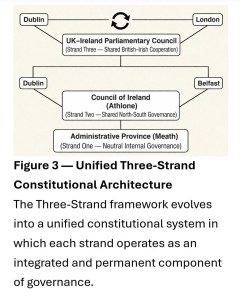
With internal governance (Strand One) and North–South cooperation (Strand Two) established through the preceding institutional architecture, the next stage introduces the UK–Ireland Parliamentary Council.
This institution gives constitutional permanence to Strand Three (British–Irish relations), completing the Three-Strand framework.
The system therefore operates not as parallel arrangements, but as a Unified Three-Strand Architecture, in which:
-
internal governance
-
all-island cooperation
-
British–Irish relations
are integrated within a single, coherent constitutional structure.
Within this framework, East–West cooperation is not optional. It is constitutionally recognised, procedurally defined, and legally sustained. British–Irish engagement operates on a reciprocal and structured basis, precluding unilateral or discretionary control within the system.
Purpose and Function of the UK–Ireland Parliamentary Council
The Council forms the East–West component of the Unified Three-Strand Architecture.
Its function is coordinative rather than governing, providing a structured forum through which British–Irish relations are maintained on a consistent and transparent basis.
This provides that British–Irish relations are not mediated through Dublin alone but conducted through a shared institutional framework.
It enables:
-
parliamentary-level engagement between Ireland and the United Kingdom
-
oversight of treaty-based cooperation
-
continuity of British–Irish relations across political cycles
Through this structure, cooperation becomes predictable, law-based, and institutionally sustained.
How the Council Operates
The Council functions through standing institutional mechanisms that enable regular engagement between both jurisdictions.
Deliberation proceeds through defined procedures supporting balanced participation and transparency. Stormont participates directly within Strand Three institutions through mechanisms aligned with devolved representation, so that engagement is not conducted without its involvement.
Its operation is treaty-based rather than discretionary, reinforcing continuity and stability in British–Irish relations.
Sessions are conducted on a rotational basis between Dublin and London, supporting institutional balance and reinforcing the non-dominant character of East–West cooperation.
Institutional Position within the Constitutional System
The UK–Ireland Parliamentary Council does not exercise governing authority within the constitutional system.
It does not override:
-
Stormont
-
Leinster House
-
the Administrative Province
Instead, it provides a structured external interface through which British–Irish relations are maintained alongside internal governance.
Participation in external institutional or democratic frameworks may continue on a voluntary and legally defined basis.
This may include:
-
participation in United Kingdom democratic processes
-
engagement with Commonwealth structures
-
cultural or ceremonial recognition of British institutions
Such participation is:
-
voluntary
-
individually exercised
-
external to the constitutional system
It does not confer governing authority within the shared constitutional order.
Integration Without Absorption
The Council does not merge governance systems or create dual authority.
It maintains a clear constitutional distinction between:
-
internal governance within the island
-
external cooperation with the United Kingdom
British–Irish relations are preserved without altering constitutional balance.
Cooperation is structured, predictable, and institutionally sustained rather than improvised.
Why the Council Completes the System
Without a permanent East–West institution, the constitutional framework would remain incomplete, leaving British–Irish relations dependent on political discretion.
By establishing the UK–Ireland Parliamentary Council, the system gives full institutional expression to:
-
Strand One (internal governance)
-
Strand Two (North–South cooperation)
-
Strand Three (British–Irish relations)
These are no longer parallel political arrangements. They operate as interdependent components of a single constitutional system.
This structural integration is illustrated below:
 The Parity Accord