Frequently Asked Questions

A concise guide for policymakers, academics, NGOs, and peace practitioners.


1. What Problem Does the Parity Accord Solve — and Why Is a New Model Needed?

The Parity Accord addresses a constitutional problem for which no existing model provides a stable solution: how two equally legitimate national identities can share one state without domination, absorption, or territorial victory.

Traditional constitutional systems rely on majoritarian rule, territorial sovereignty, or a single dominant identity. In divided or post-conflict societies, these assumptions convert constitutional change into a winner–loser event, making stability contingent on demographics rather than consent.

The Parity Accord begins from a different premise: that identity conflict is not a failure of politics, but a failure of constitutional design. Where existing models force communities to choose between separation and submission, Paritism reframes the problem as one of structural non-domination, requiring a new constitutional logic rather than incremental reform.

This question establishes why reform is insufficient — not yet how the new system works.


2. What Makes the Parity Accord Structurally Distinct from Existing Constitutional Models?

The Parity Accord is not a variation of existing constitutional forms. It introduces a new system-category, defined by the interaction of the following structural mechanisms:

  1. Constitutionalised Tier‑Two Identity Protection – Grants sovereignty‑equivalent guarantees of permanence and non‑dominance, placing identity protections beyond majoritarian override while remaining within a single sovereign state.

  2. Identity‑Anchored Shared Sovereignty – Establishes one Tier‑One state sovereignty alongside a Tier‑Two constitutional identity layer, decoupling identity from territorial victory and preventing sovereignty from becoming a zero‑sum outcome.

  3. Neutral Administrative Centre – Creates a constitutionally non‑aligned seat of governance, removing the historic victory/defeat dynamic of contested capitals and dissolving the North–South territorial binary.

  4. Overlapping, Reparative Representation – Restores representational continuity across communities without altering borders, correcting the constitutional rupture created by partition while avoiding duplication, secession, or fragmentation.

  5. Unified Three‑Strand Architecture – Integrates internal governance, North–South cooperation, and East–West relations into a single coherent constitutional framework, rather than parallel or discretionary arrangements.

  6. Structural Stability (Anti‑Fragility) – Embeds stability directly into the constitutional architecture itself, allowing the system to absorb political pressure through review and recalibration rather than collapse, independent of goodwill, demographics, or elite cooperation.

Taken together, these elements form a framework not classifiable as federalism, consociationalism, autonomy, or unitary redesign.

They establish Paritism as a distinct parity-based constitutional category, defined by non-dominance, identity permanence, and structural resilience rather than territory, demography, or elite accommodation.


3. Is This Only for Ireland — and Could It Evolve into a New Constitutional Genus?

No. While the Parity Accord originated in the Irish context, its core logic is structurally transferable to other divided or multi-identity societies.

To test that transferability, the author has developed companion parity frameworks for:

  • Canada

  • The United States

  • The European Union

  • The United Nations

  • South Africa

Each applies the same constitutional logic within a distinct legal and political tradition. These are presented as comparative test cases, not claims of adoption, and are available for independent academic and policy review.

In comparative constitutional theory, a model begins to approach genus status when its structural logic proves adaptable across multiple contexts, rather than remaining bound to a single national case.

On that basis, Paritism can be examined as a distinct parity-based constitutional system — capable of refinement, evaluation, and comparative testing beyond its point of origin.


4. How is the Parity Accord structured as a constitutional model?

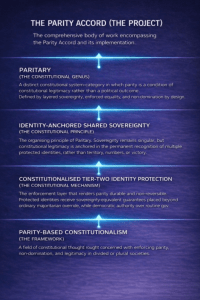
The Parity Accord is built as a layered constitutional framework, designed to separate settlement, system, and theory while ensuring they operate as a single coherent architecture.

Rather than inventing governance from scratch, the model selects, integrates, and strengthens the most resilient elements of existing constitutional systems — while removing their known failure points in divided societies.

It deliberately separates four interlocking layers, each with a distinct constitutional function:

Each layer performs a different role:

  • one establishes consent and legitimacy,

  • one defines governance and authority,

  • one guarantees identity protection, and

  • one provides the theoretical coherence that makes the system durable.

This layered structure ensures that the strongest features of existing constitutions — such as federal safeguards, rights protection, power-sharing, and treaty-based cooperation — are retained and integrated, while weaknesses such as majoritarian override, elite dependency, and territorial zero-sum logic are structurally removed.

By separating agreement, system, and theory, the Parity Accord avoids ambiguity, prevents selective adoption, and ensures that parity functions as architecture rather than aspiration.

The accompanying diagram illustrates how these four layers interlock to form a single constitutional architecture — one that is stable by design, neutral in authority, and resilient under political pressure.


5. How does this differ from majority-rule models, and can it stabilise polarised left–right politics?

Majority-rule systems create winners and losers, which fuels instability — whether between national identities or between polarised ideological blocs.
The Parity Accord avoids this by embedding shared sovereignty, neutral institutions, and constitutional non-domination, ensuring that no group or ideology can structurally overpower another.

This creates decision-making based on balance rather than victory, offering a pathway to stabilise both identity-based divisions and left–right political polarisation.


6. Is this a political campaign?

No.
The Parity Accord is not tied to any party, movement, or advocacy group.
It is a new constitutional design offering, available for examination, review, or adaptation by governments, negotiators, civil society organisations, and institutions.


7. What inspired the Parity Accord?

The Accord emerged from a long-form study of divided societies, federal structures, peace agreements, and institutional failures.
Its origins lie in the pursuit of constitutional fairness, identity protection, and structured inclusion.

For a full explanation, see the project’s Introductory Section, which outlines its development, values, and guiding principles.


8. Does the Parity Accord depart from the Good Friday Agreement?

The Good Friday Agreement was a peace settlement designed to end conflict; the Parity Accord is a constitutional framework designed to govern a shared society. It honours the democratic mandate of that settlement by providing the constitutional structure the Agreement deliberately left open.


9. Can this model realistically be implemented?

Yes.
It is drafted to fit within existing legal frameworks, including:

  • the Good Friday Agreement,

  • constitutional amendment processes,

  • treaty-based transition mechanisms, and

  • established principles of shared governance and structured power-balancing.

It provides a sequenced pathway to transition without instability or interpretative gaps.


10. Can governments use or adapt this model?

Yes.
The Accord is protected by intellectual property law, but can be licensed, examined, or adapted for:

  • constitutional reform,

  • peace negotiations,

  • academic study,

  • or institutional planning.

Inquiries are welcomed through the designated communication channel.


11. Who is the Parity Accord written for?

The Parity Accord is drafted for governments, constitutional negotiators, independent commissions, and international mediators seeking a structured path through identity-based division. It is written to the standard required for institutional review, legal analysis, and treaty-level consideration, offering a full constitutional architecture ready for examination, testing, or adaptation.

It is also accessible to academics, policy researchers, and civil society organisations who wish to explore how identity parity, layered sovereignty, and overlapping representation can be applied in complex or post-conflict environments.


12. How does symbolism fit into the Parity Accord in the Irish context?

In the Irish context, symbolism in the Parity Accord follows a simple rule: structure first, symbolism second. Any constitutional emblem associated with the Accord is intended to reflect parity, shared belonging, and constitutional balance, but symbolism is always secondary to the system itself.

As John Hume explained during Ireland’s peace process: “You can’t eat a flag.” By this, he meant that real politics is about living standards and social and economic development, not symbolic competition, and that progress ultimately comes from agreement and respect for difference.

The Parity Accord reflects this insight. In Ireland, a shared future must be built on constitutional architecture, rights, and safeguards first. Only once that structure is established can symbolism meaningfully serve it. For that reason, any emblem connected to the Accord is presented only in formal, institutional contexts and only once the model itself is under formal review.


13. Why does the author remain anonymous?

To uphold the project’s core principles of neutrality, parity, and safety.
Anonymity ensures the focus remains on the constitutional architecture, not on personality, background, or political interpretation.
It also reflects the reality that constitutional authorship in divided societies carries risk; discretion preserves both the project and the public conversation around it.


14. How do I make contact?

For licensing, consultation, or institutional review, please contact:
TheParityAccord@proton.me

All correspondence is handled in confidence and in accordance with the Accord’s intellectual-property protections.

Didn’t see your question?

Institutions, researchers, and policymakers may submit additional queries using the contact above.
Further information is available upon request.