A constitutional framework that evolves the Good Friday Agreement into a unified system of parity and shared governance.
Purpose
This document provides a concise constitutional overview of the Parity Accord.
It presents a structured model for post-agreement governance in Ireland, grounded in parity, institutional balance, and non-domination.
The framework evolves the Three-Strand structure of the Good Friday Agreement into a unified constitutional system, transforming parallel arrangements into a single, durable architecture of governance.
The model is designed for constitutional adoption through formal legal and democratic processes, ensuring enforceability rather than political discretion.
The Constitutional Problem
The Good Friday Agreement provides a framework for consent but does not define the governance arrangements that follow constitutional change.
This creates a structural gap in which:
-
sovereignty is undefined post-transition
-
institutions remain vulnerable to collapse
-
identity protection depends on political outcomes
-
British–Irish relations lack permanent constitutional anchoring
Absent prior design, constitutional change risks producing instability, uncertainty, and perceived domination.
Core Constitutional Logic
The Parity Accord addresses this through a constitutional model based on:
-
Identity-Anchored Shared Sovereignty
Authority operates across identities rather than being tied exclusively to territory. -
Constitutionalised Identity Protection
Identity is secured beyond political majorities and insulated from electoral change. -
Neutral Constitutional Centre
Authority is located in a structure not aligned with any single tradition. -
Unified Three-Strand Architecture
Governance operates as a single system rather than parallel processes. -
Structural Stability (Institutional Anti-Fragility)
Institutions are designed to absorb disagreement without collapse.
These elements ensure that parity functions as an enforceable condition of governance, not a political aspiration.
Unified Constitutional Structure
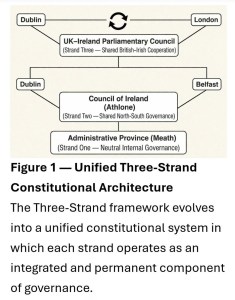
This model anchors the Three-Strand framework in defined institutional form.
The evolved structure is as follows:
-
Strand One — Internal Governance
A neutral Administrative Province (Meath) functions as the constitutional centre of authority, ensuring governance without institutional alignment to any one tradition. -
Strand Two — North–South Governance
A Council of Ireland, located in Athlone, provides a permanent institutional framework for coordinated governance across the island. -
Strand Three — British–Irish Relations
A UK–Ireland Parliamentary Council constitutionally embeds East–West relations, ensuring continuity and structured engagement between both states.
In this model, the strands no longer operate in parallel.
They function as interdependent components of a single constitutional system.
At its core, the structure is anchored by a neutral constitutional centre. This principle is developed further below.
Neutral Constitutional Centre
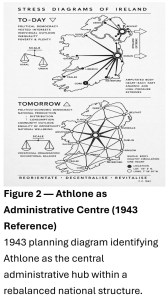
A neutral administrative centre separates authority from traditional centres of political power.
This ensures:
-
no institutional dominance by either tradition
-
balanced access to governance structures
-
stability independent of territorial control
Collectively, these elements reinforce a constitutional centre designed to prevent dominance and sustain balanced governance.
Structural Outcomes
In practical terms, the Parity Accord produces:
-
Integrated Governance
The three strands operate as a unified constitutional system. -
Permanent Identity Protection
Rights are secured independently of political majorities. -
Balanced Representation
Participation is structured across institutions and jurisdictions. -
Continuity of British–Irish Relations
East–West engagement is maintained within a defined institutional framework. -
Neutral Constitutional Authority
Governance is anchored in a location that does not align with any single tradition. -
Institutional Stability
The system is designed to function under political stress without collapse.
These outcomes reflect the underlying constitutional principles that structure the system.
Constitutional Character
This model is not reducible to devolution, joint authority, or traditional federalism.
It establishes a distinct constitutional form in which authority is shared across identities, sovereignty is structured rather than transferred, and stability is achieved through design.
In sum, these features articulate a coherent constitutional model defined by balance, enforceability, and institutional resilience.
Closing Statement
The Parity Accord does not reproduce the Good Friday Agreement.
It develops its underlying logic into a fully defined constitutional system.
It establishes the conditions under which constitutional outcomes can be determined without domination, exclusion, or instability.
Further Reading and Documentation — Evolving the Good Friday Agreement
For a full examination of the framework, readers may refer to the following documents:
-
Introduction: Evolving the Good Friday Agreement
-
The New Constitutional System
-
The Policy Paper – Sixteen Pillars
-
Strategic Defence of the Parity Accord
 The Parity Accord