A constitutional framework that evolves the Good Friday Agreement into a unified system of parity and shared governance.
Purpose
This document provides a concise constitutional overview of the Parity Accord. It presents a structured model for post-agreement governance on the island of Ireland, grounded in parity, institutional balance, and non-domination.
The framework evolves the Three-Strand structure of the Good Friday/Belfast Agreement—internal governance, North–South cooperation, and British–Irish relations—into a unified constitutional system. It transforms the three strands from parallel arrangements into interdependent components of a single, durable architecture of governance.
The model is presented for consideration and possible adoption through formal legal and democratic processes consistent with the consent-based framework established in 1998. Once lawfully adopted, its core protections would operate through constitutional and legislative rules rather than depend solely on political discretion.
The Constitutional Problem
The Good Friday/Belfast Agreement establishes the principle and procedure of consent but leaves the detailed governance arrangements following any constitutional change to be developed through lawful democratic and intergovernmental processes. Without prior consideration of those arrangements, questions may arise concerning:
-
sovereignty remains undefined after transition;
-
institutions remain vulnerable to collapse;
-
identity protection may depend on political outcomes;
-
British–Irish relations lack permanent constitutional anchoring.
If those arrangements are not developed in advance, constitutional change could generate uncertainty concerning authority, institutional continuity, identity protection, and intergovernmental relations. The Parity Accord responds by proposing a defined post-consent constitutional model, subject to democratic authorisation, legal scrutiny, negotiation, and implementation.
Core Constitutional Logic
The Parity Accord proposes a different organisation of authority within a shared constitutional system. Governance is structured to recognise identities alongside territory, identity protections are intended to remain effective beyond ordinary political majorities, and certain shared administrative functions are located outside traditional centres of political power.
The Three-Strand structure is integrated into a single system supported by safeguards designed to maintain stability under political stress. Parity is therefore treated not as an aspiration, but as an enforceable condition embedded within the constitutional order.
This logic is expressed through six core principles, developed fully in The New Constitutional System:
-
Shared Constitutional Authority;
-
Constitutionalised Identity Safeguards;
-
Neutral Constitutional Centre;
-
Overlapping, Reparative Representation;
-
Unified Three-Strand Architecture;
-
Structural Stability and Institutional Anti-Fragility.
Taken together, these principles are intended to establish a constitutional framework in which parity operates as a legally protected condition of governance, subject to the constitutional text, lawful implementation, judicial interpretation, and democratic amendment procedures.
Unified Three-Strand Constitutional Structure
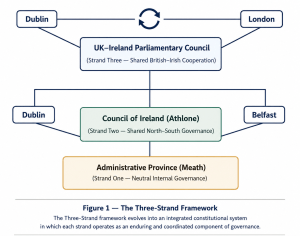
The model gives proposed institutional form to the Three-Strand framework. Governance is structured across a shared constitutional order rather than automatically re-centred in Dublin, while authority is distributed across coordinated institutions rather than concentrated in a single capital.
British–Irish engagement operates on a structured and reciprocal basis, with direct participation from Northern Ireland, including Stormont institutions. This ensures that no community or constitutional tradition is excluded from East–West decision-making.
Strand One — Internal Governance
Neutral Internal Governance,
is proposed to operate through a neutral administrative structure associated with the Administrative Province of Meath. Its intended function is to provide a shared institutional setting without identifying the constitutional centre exclusively with any single national or political tradition.
Strand Two — North–South Governance
Shared North–South governance,
is proposed to operate through a Council of Ireland, with Athlone serving as an administrative location for coordinated functions across the island. Its legal powers, composition, and relationship to other institutions would require formal constitutional and legislative definition.
Strand Three — British–Irish Relations
Shared British–Irish cooperation,
is proposed to operate through a UK–Ireland Parliamentary Council and related institutional arrangements. These arrangements would provide a structured basis for East–West relations while remaining subject to treaty, constitutional, and legislative authority.
In this design, the strands are linked as interdependent components of a coordinated constitutional system while retaining distinct functions and sources of authority. No strand is intended to operate as the governing centre of the others; authority is structured, shared, and mutually constrained through defined competences and procedures.
The framework does not seek to resolve sovereignty by assertion. It proposes to organise the exercise of constitutional authority through shared institutions, with competences distributed across the island and between relevant jurisdictions rather than concentrated in Dublin, Belfast, or London.
Neutral Centre (Meath) and Administrative Hub (Athlone)
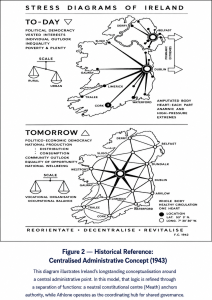
Athlone is proposed as a neutral administrative hub intended to separate the exercise of certain shared functions from traditional centres of political power.
The proposal for Meath draws on a historically significant landscape that includes Tara, Uisneach, the Boyne, and Slane. These sites can be presented as possessing layered significance across Irish, British, Christian, and wider civic narratives, although their meaning is not uniform and should not be treated as universally shared.
This layered historical association provides one rationale for considering Meath as a neutral constitutional location. It does not, by itself, establish neutrality or constitutional legitimacy; those qualities would depend on institutional design, democratic consent, legal safeguards, and public acceptance.
The design supports:
-
the absence of institutional dominance by either tradition;
-
balanced access to governance structures;
-
stability independent of exclusive territorial control;
-
separation between constitutional authority and inherited national capitals.
Collectively, Meath and Athlone reinforce a constitutional centre intended to prevent domination and support balanced governance.
What the Parity Accord Is Designed to Deliver
The Parity Accord translates its constitutional principles into practical outcomes for governance, identity, representation, institutional cooperation, and long-term stability. In practical terms, the framework is designed to deliver the following structural outcomes.
No Partition Barrier
The model enables governance and coordination across the island through shared institutions, reducing the extent to which territorial division obstructs cooperation while preserving defined jurisdictional responsibilities.
No Exclusion or Institutional Bypass
All communities participate within each constitutional strand. No dimension of governance operates without appropriate Northern Irish participation or representation of the relevant identity traditions.
Integrated Governance
The three strands operate as a unified constitutional system rather than as parallel, loosely connected arrangements.
Permanent Identity Protection
Core rights and identity protections are intended to operate independently of ordinary political majorities and to require enhanced constitutional or legal procedures for alteration. Their precise scope, limits, and remedies must be defined in the constitutional text and applicable legislation.
Balanced Representation
Participation is structured across institutions and jurisdictions to recognise British, Irish, Northern Irish, and wider civic identities and communities. The precise representation rules must balance inclusion, competence, accountability, and protection against institutional capture.
Continuity of British–Irish Relations
East–West engagement is maintained within a defined, treaty-based institutional framework, supporting stability across political cycles.
Neutral Constitutional Authority
Governance is anchored in a location that does not align with any single tradition. Authority is distributed across coordinated institutions and exercised through structural neutrality.
Institutional Stability
The system is designed to improve resilience under political stress through defined procedures, legal safeguards, constitutional protections, dispute-resolution mechanisms, and transitional arrangements. No institutional design can eliminate political disagreement or guarantee that collapse will never occur.
Together, these outcomes reflect the underlying constitutional principles of the Parity Accord and are intended to sustain the framework’s durability over time.
Foundational Constitutional Protections
The system is proposed to be structured around three core constitutional objectives and safeguards:
-
no partition barrier;
-
no exclusion or institutional bypass;
-
no central domination.
Together, these conditions define a constitutional order in which governance is exercised across the island through shared institutions, participation is structured across all three strands and communities, and authority is distributed within a neutral, coordinated framework rather than concentrated in any single capital.
Where incorporated into the constitutional text or applicable law, these protections would operate as legal requirements rather than merely political preferences. Their enforceability would depend on defined rights, institutional duties, review procedures, and remedies.
Constitutional Character
The Parity Accord is not intended to be reducible to devolution, joint authority, or traditional federalism. It proposes a distinctive combination of shared constitutional authority, identity protection, institutional neutrality, and integrated intergovernmental governance, while drawing on features found in established constitutional models.
Its defining characteristics are:
-
shared constitutional authority;
-
identity-based rather than exclusively territorial parity;
-
neutral institutional location;
-
overlapping and reparative representation;
-
integrated North–South and East–West governance;
-
enforceable protection against domination.
The features described above are intended to form a coherent constitutional model grounded in balance, parity, enforceability, and institutional resilience. Their final effectiveness would depend on precise drafting, democratic adoption, institutional capacity, judicial interpretation, and continuing public legitimacy.
Closing Statement
The Parity Accord does not reproduce the Good Friday/Belfast Agreement. It develops its underlying logic into a defined constitutional system.
Constitutional debate on the island has traditionally been framed as a binary between continuation of the Union and reunification with the Republic. This framework establishes the conditions under which constitutional outcomes can be determined without domination, exclusion, or structural instability.
It offers a possible way beyond that binary by proposing a parity-based system of shared governance grounded in balance, institutional structure, enforceability, and continuing consent.
Further Reading and Documentation
The full constitutional, structural, operational, and strategic articulation of the Parity Accord is set out across:
-
Introduction: Evolving the Good Friday Agreement;
-
The New Constitutional System;
-
The White Paper — Sixteen Pillars;
-
Strategic Defence of the Parity Accord.
 The Parity Accord